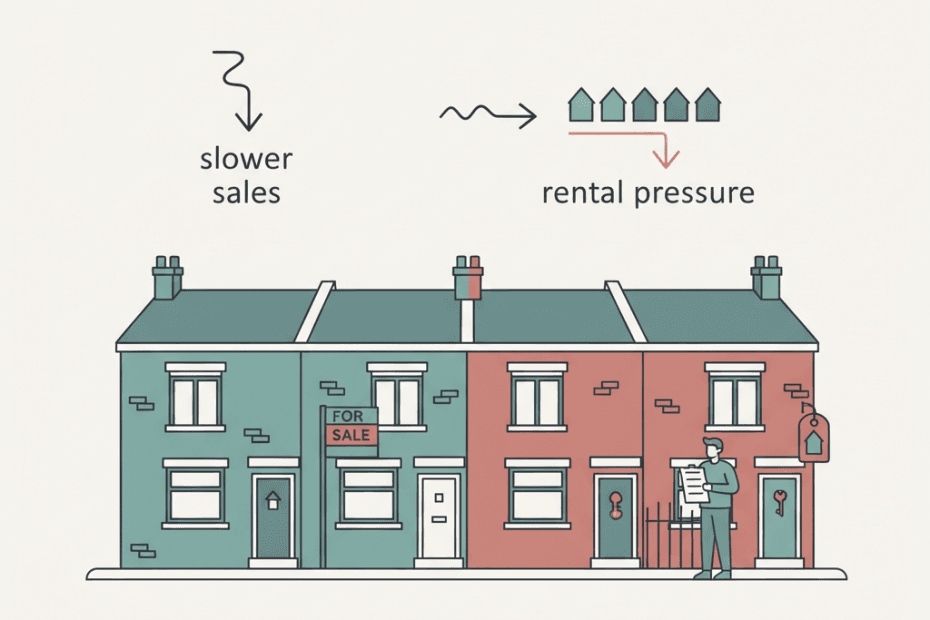
The May 2026 RICS residential market survey points to a housing market that is still struggling for momentum, with weak buyer demand, subdued sales and continuing pressure in the rental sector.
Property Industry Eye reports that the latest RICS survey shows buyer demand remains weak, while the rental market is still being shaped by a shortage of available homes. For landlords, the significance is not only what is happening to sale prices. A slower sales market can affect tenant demand, exit plans, valuations, remortgage decisions and the time it may take to sell a property if circumstances change.
This is a market update, not investment, mortgage, tax or legal advice. Landlords making portfolio, borrowing or sale decisions should use current figures for their own properties and take professional advice where needed.
What the survey suggests
The headline message is that the sales market remains soft. RICS survey indicators cited in wider market coverage show new buyer enquiries and agreed sales still in negative territory in May, with house price sentiment also weak. That does not mean every local market is moving in the same direction, but it does suggest that buyer caution has not disappeared.
For landlords, the sales side matters even where there is no immediate plan to sell. If demand is thinner, sales may take longer and pricing expectations may need more care. It can also affect how quickly accidental landlords, retiring landlords or heavily leveraged owners can change course if cash flow, regulation or personal circumstances shift.
The rental picture is different. RICS has continued to describe a market where tenant demand and available landlord supply are not comfortably balanced. April’s RICS survey, for example, reported tenant demand rising on a net balance basis while landlord instructions remained negative. The May coverage suggests that rental pressures remain part of the wider market story, even as the sales market looks subdued.
Why weak buyer demand can feed back into lettings
A weak sales market does not automatically make letting easier. It can create mixed effects. Some would-be buyers may stay in rented accommodation for longer if affordability, mortgage rates or uncertainty hold them back. That can support tenant demand, particularly in areas where first-time buyers and renters compete for similar homes.
At the same time, landlords who want to sell may find the process slower or less predictable. A property that takes longer to sell can create practical questions around notice periods, voids, repairs before listing and whether to keep a tenancy running while plans are reviewed. Those are operational issues, not just market headlines.
There is also a standards angle. In a market where renters have fewer options, landlords should avoid treating demand as a substitute for good management. Property condition, repair records, affordability checks, communication and compliance paperwork remain important. Here4Landlords has previously covered why rental supply pressure is something landlords should watch, and the same principle applies here: market pressure does not remove the need for careful records and fair process.
What landlords can sensibly review
First, look at local evidence rather than relying on national mood music. RICS surveys are useful indicators, but landlord decisions are often shaped by street-level demand, property type, condition, local employment, transport links and competing supply. A two-bedroom flat in one city may behave very differently from a family house in another.
Second, keep sale planning realistic if an exit is possible in the next year. That means thinking about the order of work: tenancy timing, repair issues, certificates, inventories, access for valuations, and how the property would be presented if it went to market. None of that requires a decision to sell now. It simply reduces avoidable friction if a decision is later made.
Third, stress-test void and maintenance assumptions. A landlord whose property remains let may feel insulated from a weaker sales market, but cash flow can still be affected by repairs, mortgage costs, insurance, service charges or compliance work. The useful question is not whether the market is good or bad in the abstract, but whether the property still has enough margin to absorb routine shocks.
Fourth, keep rent reviews evidence-led. Where rental demand is strong, it can be tempting to assume rents can simply keep rising. Landlords should still consider local comparables, affordability, property condition, tenancy history and the rules that apply to rent increases. A defensible process matters, especially as reform continues to change the private rented sector. Our guide to the Renters’ Rights timetable sets out why paperwork and dates deserve close attention.
The landlord takeaway
The latest RICS picture is not a simple good-news or bad-news signal for landlords. A weaker sales market may keep some pressure in the rented sector, but it can also make portfolio changes slower and more sensitive to pricing, timing and finance.
The practical response is to stay grounded. Review local evidence, keep property records tidy, avoid relying on national averages, and make sure any rent, sale or refinancing decision is based on current figures for the individual property. In a market with weak buyer demand and constrained rental supply, careful administration is as important as headline confidence.
Sources: Property Industry Eye; RICS April 2026 UK Residential Survey.